
In this post9 sections
- What Kajabi costs in 2026
- The alternatives, side by side
- What a $200 sale really costs you
- How to read that table
- The alternatives, one by one
- Teachable
- Thinkific
- Podia
- Circle
- Skool
- Systeme.io
- Where Gadura sits
- A short way to decide
- Questions people ask
- Is Kajabi worth the price?
- What is the cheapest Kajabi alternative with no transaction fee?
- Can I move my courses and audience from Kajabi?
- Which is best for a community?
- About this comparison
If you are pricing up Kajabi for a course, a community or a membership business, you are probably also looking at what else is out there. This is a plain comparison of the seven platforms creators most often weigh against Kajabi, with the prices each company published on 11 October 2026, the fees that change the real cost, and a short way to decide. Prices change; check the page before you commit. Where a company shows a price only for annual billing, that is what we quote.
What Kajabi costs in 2026
Kajabi lists three plans: Basic at $179 a month ($143 billed annually) with 5 products and 2,500 contacts, Growth at $249 a month ($199 annually) with 50 products and 25,000 contacts, and Pro at $499 a month ($399 annually) with unlimited products and 100,000 contacts. Payments through Kajabi Payments carry a processing fee of 2.9% plus 30 cents on Basic, falling to 2.7% plus 30 cents on Pro; a third-party processor adds a platform fee of 2%, 1% or 0.5% by plan. There is a free trial.
Kajabi is a complete, polished system and the price reflects it. The question is whether you need all of it at that price, and what you give up elsewhere to get it.

The alternatives, side by side
Platform | Entry plan | Mid plan | Transaction fee on the platform's own plans | Trial |
|---|---|---|---|---|
Kajabi | $179/mo (5 products, 2,500 contacts) | $249/mo (50 products, 25,000 contacts) | Processing 2.7% to 2.9% + 30¢; third-party processor adds 0.5% to 2% | Free trial |
Gadura | $79/mo ($66 annually): 5 studios, 1,000 contacts, 2 communities of up to 100 members | $149/mo ($124 annually) | No Gadura commission; Stripe's own fees on your own Stripe account | 14 days free, card taken, nothing charged in the trial |
Teachable | $39/mo ($29 annually), 7.5% transaction fee, 5 products | $89/mo ($69 annually), 0% fee, 10 products | 7.5% on Starter, 0% above, plus processing 2.9% + 30¢ | 7 days free |
Thinkific | £46/mo (£34 annually), 1 community | £92/mo (£69 annually), 1 community | 2.9% with Thinkific Payments | 30 days free |
Podia | $42/mo, 5% fee, 100 email subscribers | $84/mo, no fee, 500 subscribers | 5% on Mover, none above | 14 days free |
Circle | $89/mo (annual billing), unlimited members, 2% fee | $199/mo (annual billing), 1% fee | 0.5% to 2%; email is an add-on at $99/mo | Not stated on the pricing page |
Skool | $9/mo with a 10% transaction fee | $99/mo with a 2.9% fee | 10% or 2.9% | Free to try |
Systeme.io | Free: 2,000 contacts, 1 course | $17/mo: 5,000 contacts, 5 courses | None | Free plan |
Thinkific publishes its prices in pounds on its UK page; the others publish in dollars.
What a $200 sale really costs you
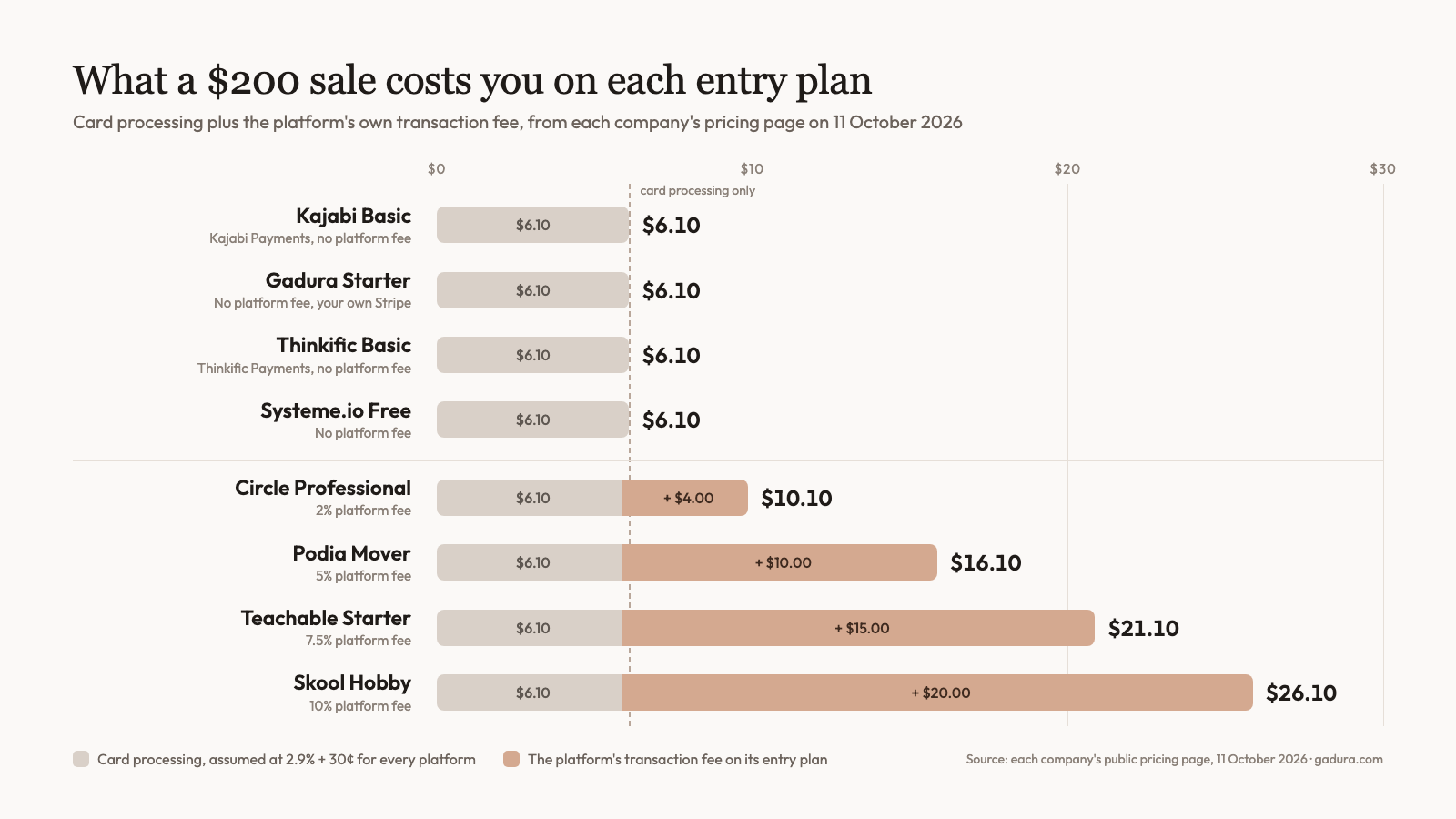
Transaction fees change the real price. A platform fee of 5% or 10% on a $200 course is $10 or $20 per sale, every sale, for as long as you sell. Skool's Hobby plan at $9 a month looks cheap until you sell; Teachable's Starter plan carries 7.5%. Kajabi's third-party fee of up to 2% sits on top of normal processing. Gadura, Podia above its first plan, and Systeme.io take no cut of your sales; you pay the card processor and nothing else.
How to read that table
Contacts and members are the limits that bite first. Kajabi's Basic plan stops at 2,500 contacts; Gadura's Starter at 1,000 contacts and 100 members per community; Podia's Mover at 100 email subscribers. Count the audience you have today and the one you expect in a year, and price the plan you would actually be on.
Email is where platforms split. Kajabi, Gadura, Podia and Systeme.io include email in the plan. Circle charges $99 a month on top for its Email Hub. Skool's pricing page did not mention email on the day we checked. If your business lives on a list, that difference is bigger than the headline price.
If your business lives on a list, that difference is bigger than the headline price.
Communities are not all the same thing. Thinkific's lower plans allow one community; Circle and Skool are built around the community and treat courses as a feature inside it; Kajabi and Gadura treat the community as one product beside courses, email, bookings and a website.
The alternatives, one by one
Teachable
Starter is $39 a month ($29 billed annually) with 5 products and a 7.5% transaction fee; Builder is $89 ($69 annually) with 10 products and no fee; Pro is $189. The trial is 7 days. Best for a course-first creator with a small catalogue who wants the lowest first month. Watch the Starter fee: if you expect to sell, price the Builder plan instead.
Thinkific
On its UK page, Basic is £46 a month (£34 annually), Start is £92 (£69 annually) and Grow is £186, with one community on the lower plans and 2.9% through Thinkific Payments. The trial is 30 days, the longest in this table. Best for a course business that wants a month to try before paying. Watch the single community on the lower plans if community is part of your plan.
Podia
Mover is $42 a month with a 5% fee and 100 email subscribers; Shaker is $84 with no fee and 500 subscribers; Earthquaker is $150. The trial is 14 days. Best for a simple shop of courses, downloads and coaching at a low entry price. Watch the email limits, which arrive early for anyone building a list.
Circle
Professional is $89 a month on annual billing with unlimited members and a 2% fee; Business is $199 on annual billing with a 1% fee; Enterprise is $419. Email is an add-on at $99 a month, and the pricing page does not state a trial. Best for a business where the community is the product and courses live inside it. Watch the add-on and the per-sale fee when you compare it with an all-in-one price.
Skool
Hobby is $9 a month with a 10% transaction fee; Pro is $99 with a 2.9% fee; it is free to try. Best for one community with a simple course area and the smallest possible start. Watch the 10% on Hobby, which is $20 of every $200 sale, and the absence of email on the pricing page.
Systeme.io
The free plan allows 2,000 contacts and 1 course; the next plans are $17, $47 and $97 a month; there is no transaction fee. Best for starting at zero. Watch the limits of the free plan and price the plan you would be on once the list grows.
Where Gadura sits
Gadura is built for a creator who wants the whole business in one place without a platform taking a share of each sale: courses (Studios), paid communities, a website with a blog and podcast, Email Studio, offers and checkout, funnels and automations, bookings, and webinars. Plans are $79, $149 and $299 a month, or $66, $124 and $249 billed annually, with a 14-day free trial; the detail is on the pricing page. You connect your own Stripe account, so money from your customers goes to you, and Gadura charges no commission. The honest trade: Gadura is newer than Kajabi, with a smaller template library and a younger integrations list. If you want ten years of ecosystem, Kajabi has it. If you want the full set of tools at a third of the price and no cut of your sales, that is what Gadura is for.
A short way to decide
You sell mostly courses, have a small list, and want the cheapest start: Teachable Builder or Podia Shaker, both without transaction fees.
Your business is the community first: Circle, or Skool if you can live with the fee.
You want everything in one place and a zero-commission model: Gadura, or Kajabi if its price is comfortable.
You are at zero and need free: Systeme.io's free plan.
Whatever you choose, read the fee line, not just the plan price, and run the numbers on the audience you expect to have in twelve months.
Questions people ask
Is Kajabi worth the price?
For a business that uses most of it, yes: it is complete and polished. If you use courses and email and little else, you are paying for breadth you do not use, and the table above shows what that breadth costs elsewhere.
What is the cheapest Kajabi alternative with no transaction fee?
Systeme.io's free plan, then Gadura Starter at $79 ($66 annually), Podia Shaker at $84 and Teachable Builder at $89 ($69 annually). Thinkific's 2.9% through its own payments is card processing rather than a platform cut.
Can I move my courses and audience from Kajabi?
Every platform here lets you upload your videos and bring your contacts in from a file; the work is in rebuilding pages and emails. On Gadura, contacts import from a CSV with a question about who agreed to hear from you, and lessons are built from your uploaded video and text.
Which is best for a community?
If the community is the business, Circle and Skool are built around it. If the community sits beside courses, email and a website, Kajabi and Gadura treat it as one product among several.
About this comparison
Prices and plan limits were read from each company's public pricing page on 11 October 2026 and are quoted in the currency shown there. We have not tested every plan. Kajabi, Teachable, Thinkific, Podia, Circle, Skool and Systeme.io are trademarks of their owners, who are not connected with Gadura. This comparison is written by the Gadura team; we have tried to be fair to everyone in the table, and we will correct any error you tell us about at support@gadura.com.
 Start your 14-day trial on GaduraBuild it on GaduraYour courses, community, email and website in one place. 14 days free, then the plan that fits.Start your free trial
Filed under Pricing and Systems

The people who build Gadura, writing about the craft of running a creator business: pricing, products, email, community and getting found.
More from The Gadura team